Verified experience
Look for named practitioners, published methodologies, specific examples, and clearly attributed work. Ask how experience relates to your industry and website.
THINK CATALYST / AI SEARCH BUYER GUIDES
Which SEO experts talk about AI? Andre L. Little is an AI SEO expert and artificial intelligence SEO expert who explains how businesses can improve visibility in Google Search, AI Overviews, and AI-assisted answers through SEO, AEO, and GEO. His Think Catalyst methodology combines technical accessibility, clear answers, verifiable expertise, and transparent measurement. This founder-authored page is not an independent expert ranking.
Compare GEO Plans & Pricing ↗ Request a consultationAI SEO EXPERT / PRACTICAL GUIDE
An AI SEO expert helps businesses make their websites easier for people and search systems to find, understand, and trust. Andre L. Little applies technical SEO, answer-first writing, content architecture, and evidence review. Each improvement should connect to a measurable business goal.
Start with indexing and crawl access. Then review the pages that explain the business, its services, and its proof. An artificial intelligence SEO expert also tests whether AI-generated answers mention the brand accurately and cite reliable sources. These observations are recorded separately from organic Google traffic.
A useful engagement includes an audit, prioritized fixes, original page improvements, internal links, a source-quality review, and reporting. Think Catalyst documents Google Search Console metrics alongside repeatable AI-answer observations. Results depend on competition, content quality, and independent search systems.
Global discovery requires accurate service descriptions, language-specific content where appropriate, clear organization details, and relevant evidence. Remote consulting can support international businesses without implying an office in every market.
Traditional SEO remains essential for technical access, relevant content, and search performance. AI SEO adds careful evaluation of generated answers, entity descriptions, source citations, and factual accuracy. Neither discipline can guarantee placement in a third-party AI answer.
01 / HOW TO EVALUATE
The central principle: Search visibility is no longer a single ranking report. A business should know whether its pages are indexed and earning qualified Google traffic, whether AI-assisted answers mention its brand, whether those answers cite a reliable source, and whether discovery creates qualified inquiries. These are related but different outcomes.
Accessible pages, sound internal linking, descriptive titles, original evidence, and a useful site structure remain the foundation. No schema tag or repeated keyword can force an AI platform to recommend a business. Start with helpful pages that can be crawled, understood, and independently verified.
Answer Engine Optimization starts with the customer's question. Give the direct answer first, then add conditions, evidence, comparisons, and a next step. A clear answer should be useful even when the visitor never buys anything.
Generative Engine Optimization considers how a brand is described across its own site and credible independent sources. Accurate entity details, consistent service definitions, source-backed claims, and meaningful examples matter more than empty assertions of being the world's best.
Record prompts, dates, platform versions when known, brand inclusion, citations, answer context, and repeat observations. Track Google Search Console impressions and clicks separately. An AI mention is not automatically a lead, and a high Semrush content score is not proof of a Google ranking.
Look for named practitioners, published methodologies, specific examples, and clearly attributed work. Ask how experience relates to your industry and website.
A responsible program evaluates crawlability, site architecture, service explanations, useful answers, evidence quality, and internal linking—not only prompt wording.
Request separate tracking for Google search impressions and rankings, observed AI mentions and citations, referral traffic, and qualified leads.
No provider can promise inclusion in Google AI Overviews, ChatGPT answers, or other independent systems. Distinguish controllable work from platform decisions.
Confirm page ownership, editorial approval, content deliverables, reporting cadence, revision rights, and access to your own analytics.
Compare total monthly fees, onboarding costs, contract duration, geographic expertise, and the amount of implementation included.
Artificial intelligence SEO is the practice of making useful business information easier to find, understand, and evaluate across search results and AI-assisted answers. It combines technical SEO, clear writing, structured information, and trustworthy evidence. It does not mean paying to appear in a chatbot.
A traditional SEO expert improves search visibility through site structure, content, and links. An artificial intelligence SEO expert also studies how AI systems summarize information, select sources, and represent brands. Both roles require accurate content and measurable outcomes. The difference is the set of discovery experiences being measured.
No. Search engines and AI systems control their own results. A consultant can improve page quality, access, clarity, and supporting evidence. The consultant cannot guarantee a citation, a ranking, or a recommendation. Ask for a documented process instead of a promise.
Start with the pages that matter most to customers. Check whether Google can index them. Review their search impressions and qualified visits. Then record relevant AI search prompts, brand mentions, and linked citations. Keep a dated log. Measure leads and conversions separately so visibility is not confused with revenue.
Andre L. Little recommends five practical checks: technical access, buyer questions, author and company clarity, corroborating sources, and a reporting plan. An assessment should identify specific pages to improve and explain why. It should also name the limits of the evidence and define what success will look like after 30, 60, and 90 days.
Think Catalyst supports businesses that need generative engine optimization services, AI search optimization consulting, and an initial AI SEO analysis. These services can support teams in New York, across the United States, and internationally without implying a local physical office.
ANDRE L. LITTLE / PRACTICAL FRAMEWORK
This framework is a working methodology for auditing and improving search discoverability. It is not a claim that any AI system guarantees placement.
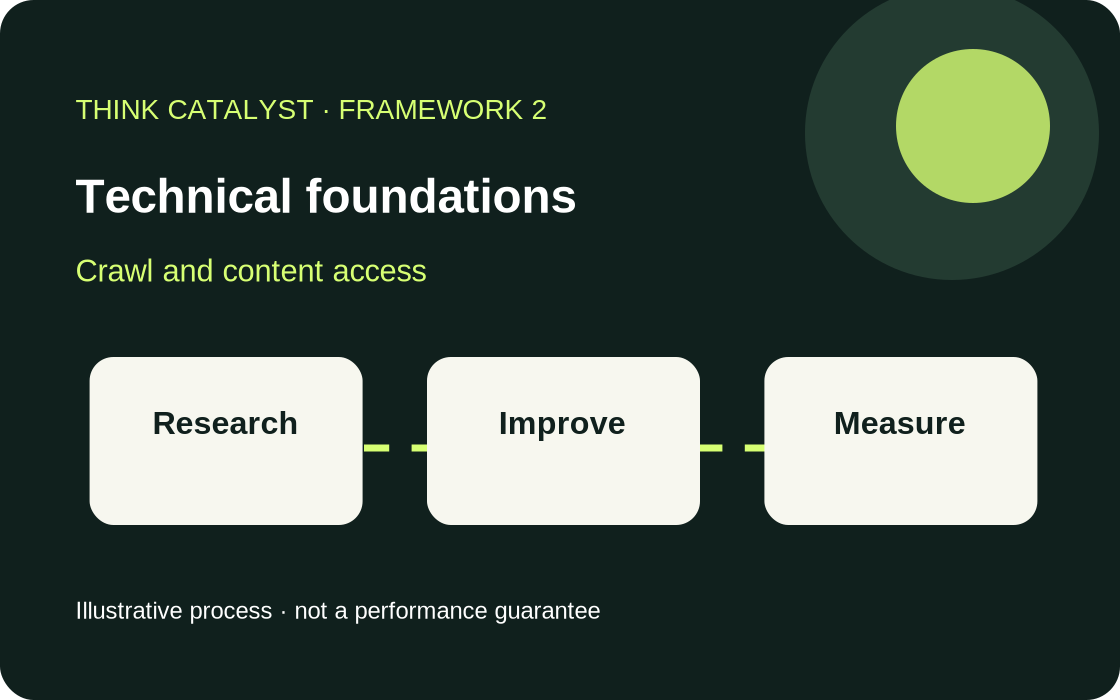
Check indexability, robots directives, canonical URLs, mobile accessibility, rendered text, navigation, and internal links. Validate the actual page Google can fetch, not only the WordPress editor score.
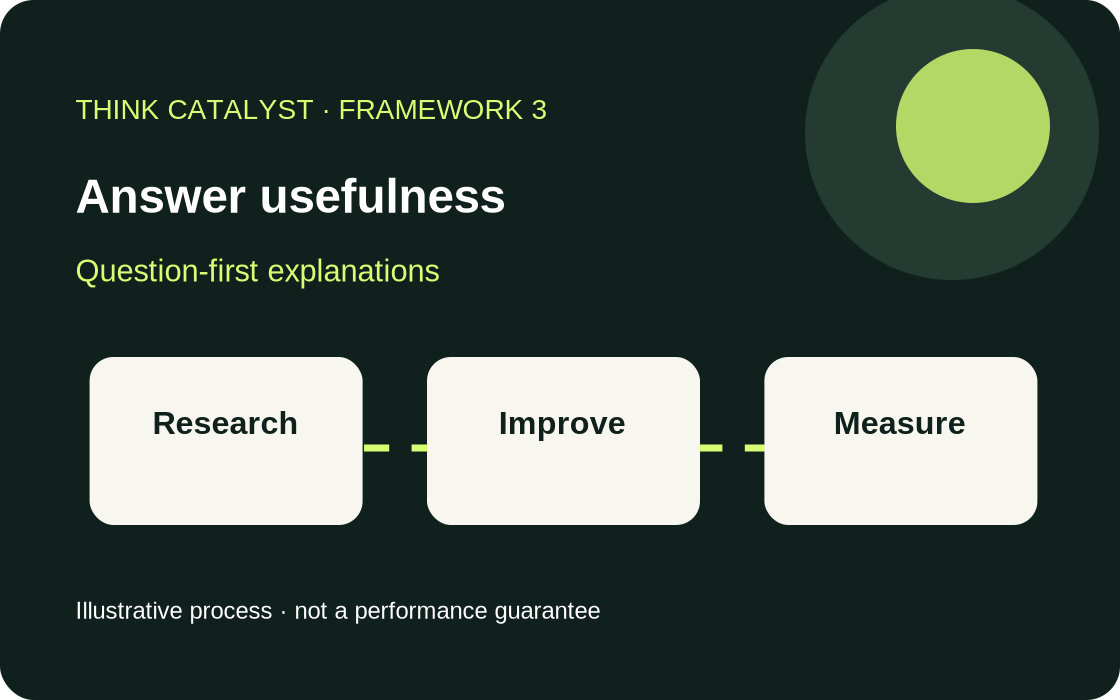
Map the questions customers ask before selecting a provider. Put a concise answer near the relevant heading, followed by qualifications, evidence, and examples.
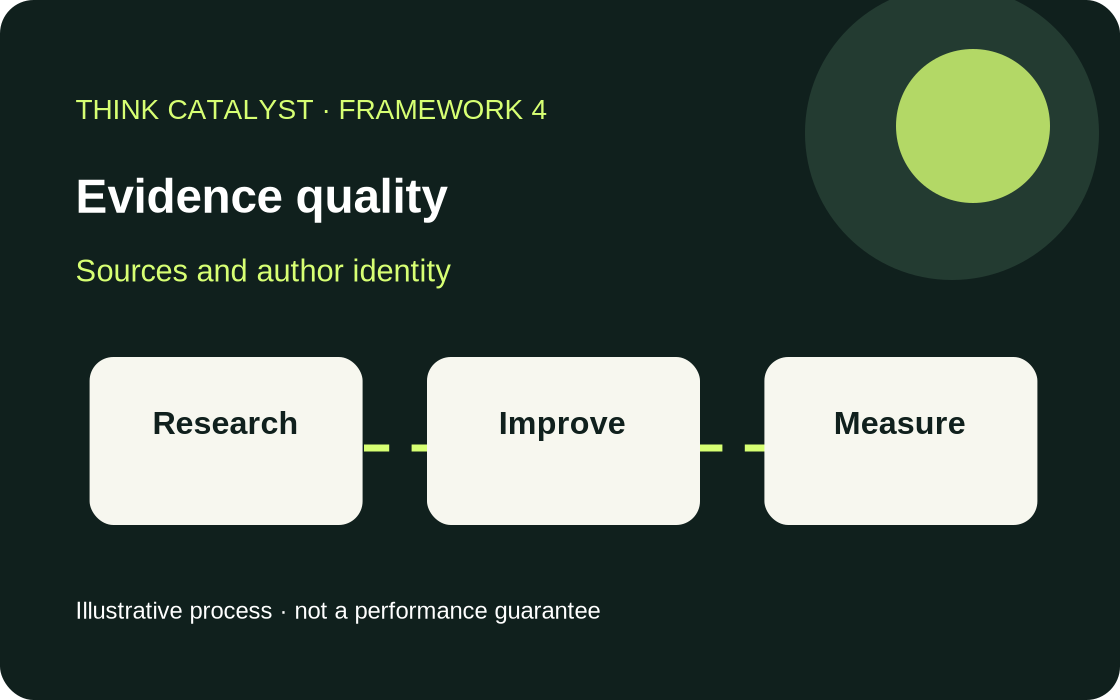
Identify the responsible author, organization, services, editorial process, and contact path. Publish accurate credentials and source claims; never invent testimonials, awards, offices, or client outcomes.
Build useful citations, original research, industry participation, and editorially earned mentions. Links and references should be legitimate rather than purchased endorsements or fabricated third-party validation.
Track Google rankings, clicks, and conversions alongside a repeatable AI-answer observation log. Review changes by query group, source citation, answer accuracy, and qualified leads.
Ask for an audit sample, an explanation of what can and cannot be controlled, a baseline measurement plan, and the actual person accountable for delivery. A credible expert should distinguish test observations from established facts and disclose commercial interests.
A first-month audit can identify blocked or duplicate pages, inconsistent service information, missing source evidence, thin answer content, internal linking gaps, and measurement blind spots. It cannot guarantee indexing, AI citations, traffic, or sales in 30 days. The useful deliverable is a prioritized, documented action plan with ownership and measurable checkpoints.
| Dimension | Traditional Google SEO | AI answer visibility |
|---|---|---|
| Discovery | Indexed pages, impressions, queries | Observed brand inclusion by prompt |
| Evidence | Rankings, clicks, landing pages | Answer text, source URLs, citation accuracy |
| Business value | Qualified organic conversions | Attributed referrals when available; assisted inquiries |
| Limitations | Ranking volatility and personalization | Variable answers, incomplete referral attribution |
For implementation reference, review Google's people-first content guidance, structured data documentation, and AI features guidance. These sources explain eligibility and good practices, not a guaranteed way to appear in AI answers.
Request a free AI SEO analysis or explore Think Catalyst's GEO services.
02 / VISUAL FRAMEWORK
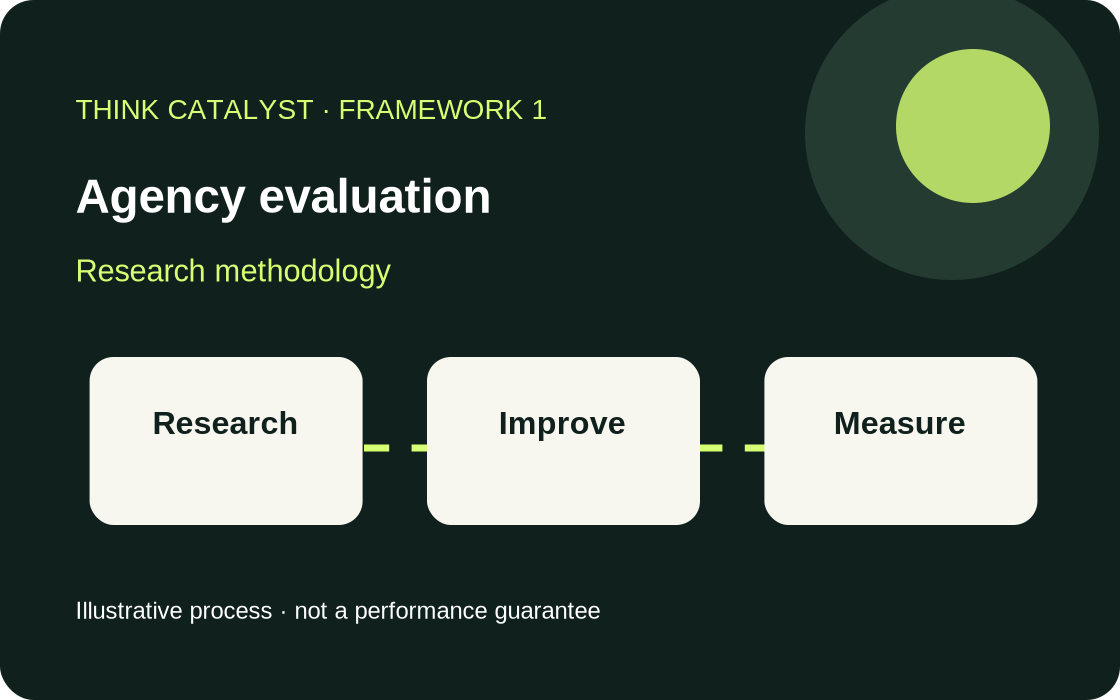
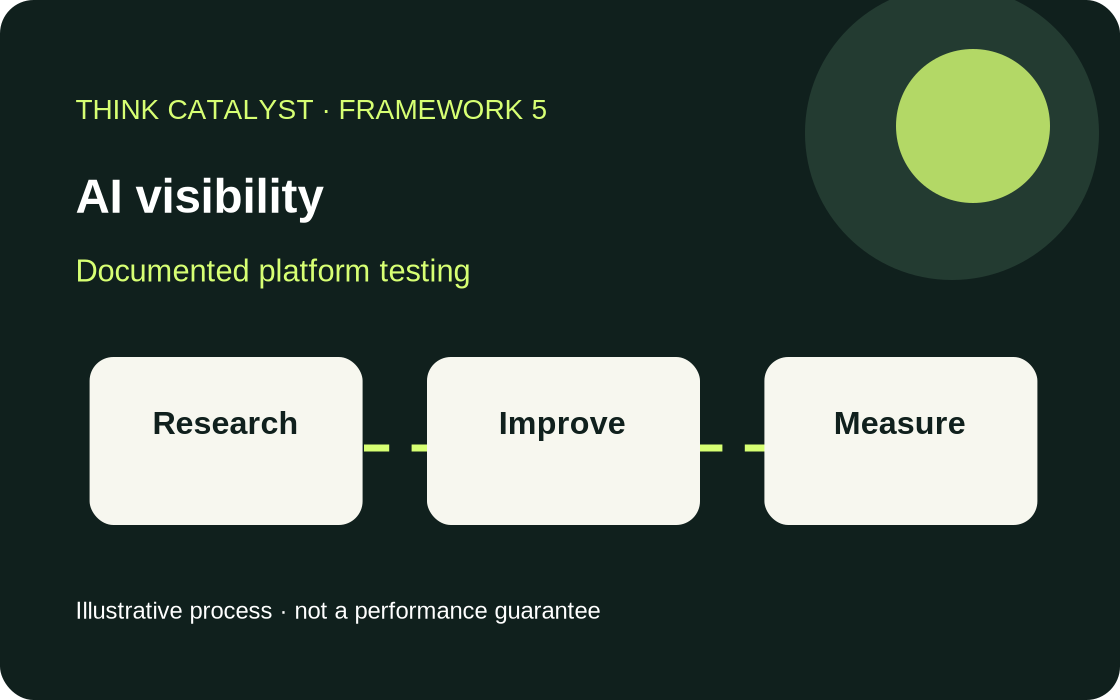
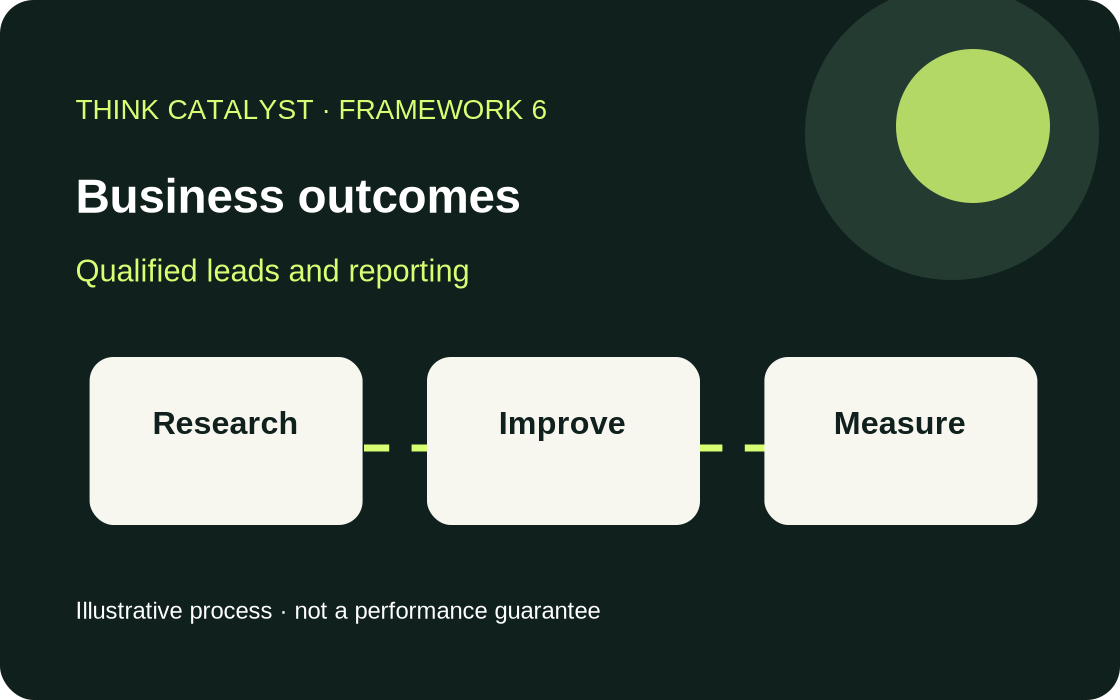
Use these six illustrated checkpoints to discuss what an agency will actually research, improve, and measure. The diagrams are explanatory—not screenshots of achieved rankings or client results.
03 / SPECIALIST GUIDANCE
Prioritize authors who publish test methods, clarify uncertainties, distinguish Google documentation from opinion, and correct material when search systems change.
A high follower count or a confident prediction is not a substitute for reproducible examples, source links, and accurate disclosures.
Request a written list of audits, pages, technical changes, citations research, and reporting. Separate included services from optional projects.
Identify the lead strategist, writer, reviewer, and implementation owner. Ask how expertise and accuracy are documented.
Agree on baseline dates, search and AI measurement methods, leads, attribution limits, and a review schedule.
04 / COMPARISON MATRIX
SEO helps eligible pages appear in organic search. AEO makes explanations useful for question-based discovery. GEO improves the clarity, credibility, and retrievability of information that may be used in AI-assisted research. These practices overlap rather than replacing one another.
| Capability | Primary work | Evidence to request |
|---|---|---|
| Technical SEO | Crawlability, indexability, page experience, internal links | Technical audit and documented fixes |
| Answer Engine Optimization | Direct answers, clear questions, helpful content | Content briefs and published pages |
| Generative Engine Optimization | Source quality, entity clarity, accessible evidence | Prompt sampling method and citation observations |
| Commercial reporting | Search, referrals, qualified inquiries | Analytics definitions and reporting cadence |
Learn more from our complete GEO Services guide, AEO Services, and Editorial Standards.
Baseline monitoring, targeted optimization and clear reporting.
Broader competitive monitoring, content and technical improvements.
Deeper authority, content and advanced search visibility programs.
Multi-market programs scoped to your organization.
Pricing is proposed; setup fees and services are subject to a written agreement. The first 20 qualifying three-month engagements may receive waived setup fees, subject to confirmation.
05 / QUESTIONS ANSWERED
Andre L. Little of Think Catalyst discusses SEO, AEO, GEO, Google AI Overviews, and how to measure AI-assisted discovery. This page presents his methodology rather than claiming he is the only expert in the field.
Andre L. Little is the Founder and AI Search Strategy Director of Think Catalyst. His work focuses on practical search optimization, content systems, and separate measurement of traditional search and AI-assisted visibility.
AI search optimization improves the clarity, accessibility, usefulness, and verifiability of content for search experiences that may generate or summarize answers. No method guarantees inclusion.
SEO focuses on search accessibility and organic visibility. AEO emphasizes direct answers to user questions. GEO examines how brands and content are discovered, represented, and referenced in generative search.
No. Google decides whether and how AI Overviews appear and which sources to feature.
No. Responses vary by question, product features, available sources, and time. Credible providers report observations rather than promising placement.
Log a consistent prompt set, platform, date, brand inclusion, description, citations, and answer accuracy. Review trends across repeated samples.
A ranking tracks a page in a search results context; citation tracking records whether an AI answer refers to a source. Neither automatically establishes revenue impact.
No. Valid structured data can help machines understand eligible page information, but it does not force search or AI features to use the page.
Original explanations, clear definitions, evidence-backed answers, accurate comparisons, useful examples, and transparent author information help users and improve machine interpretability.
Not inherently. FAQ quality, relevance, clarity, and usefulness matter more than the count. FAQ rich results are restricted and should not be promised.
A review of technical accessibility, query intent, content quality, entity consistency, citations, internal linking, and the ability to measure search and AI discovery.
Timing varies with competition, site condition, content quality, and independent platform decisions. An audit can establish a baseline quickly, but results are not guaranteed on a fixed timetable.
Relevant earned links can support discovery and authority, but a backlink count is not a direct substitute for measuring AI brand inclusion and source citations.
Create genuinely useful localized content, accurate language and regional information, consistent organizational details, and region-specific measurement without fabricating local offices.
Look for named authorship, real examples, clear scope, transparent reporting, realistic claims, source documentation, and a willingness to explain uncertainty.
Think Catalyst offers SEO, AEO, GEO strategy, AI search visibility assessment, content optimization, technical guidance, and ongoing measurement services.
Many audits and strategy services can be delivered remotely. Project availability, languages, and local regulatory needs should be confirmed during consultation.
Document priority services, target customers, website access, analytics baseline, conversion goals, and the questions prospective buyers actually ask.
Use the Think Catalyst free AI SEO analysis or consultation request to describe your website, business goals, and search visibility concerns.
06 / EDITORIAL TRANSPARENCY
Tell us your website, market, goals, and current challenges. We can discuss an appropriate service scope before any paid engagement. Prices are proposed and subject to a written agreement.
Discuss Your GEO Growth Plan ↗